


“Comparison Is the Thief of Joy”
Theodore Roosevelt said it over a century ago, and somehow, in the age of the highlight reels, it’s more true than ever.
For athletes, comparison is a relentless, structured part of the sporting experience. Leaderboards. Lap times. Podium finishes. Weight categories. Body composition assessments. Selection decisions made visible. You are measured against others constantly, often publicly, and the message absorbed over time may be that your worth is determined by where you rank.
Then you open your phone, and it starts all over again.
Why athletes are particularly vulnerable
Social Comparison Theory — tells us that human beings naturally evaluate themselves in relation to others, when we used to live in tribes it might’ve been the difference of not getting left behind so long as you’re keeping up with the neolithic Jones’s, it meant survival then. So we still look upward at those we perceive as better off, and downward at those we perceive as worse off. In sport, this tendency is not just natural; it is structurally embedded. Comparison is the mechanism by which sport operates.
The problem is that the comparison does not stay on the track, in the pool, or on the mat. It follows athletes into the changing room, onto social media, and into how they think about their bodies, their sense of identity, and their relationship with performance.
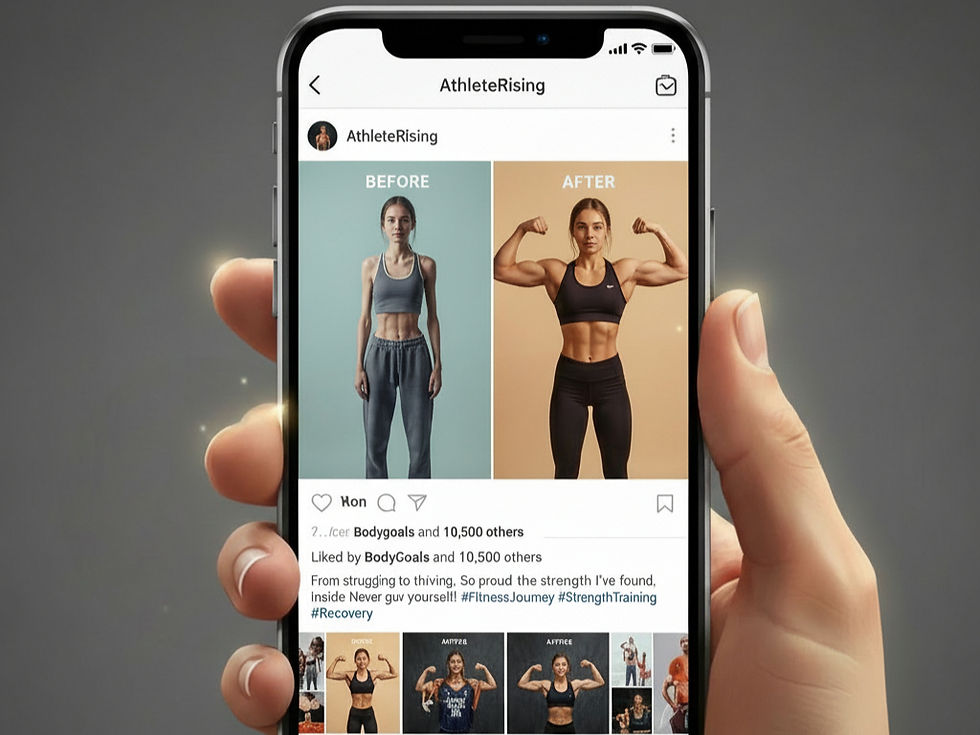
For athletes whose feeds are populated by teammates, competitors, and influencers with performance-adjacent aesthetics, the comparison is relentless and almost entirely upward. Nobody posts their worst training session. Nobody shares the day they felt slow or uncertain. What you see is curated, filtered, and frequently unrepresentative — but your nervous system does not always know that.
What comparison actually costs
At its mildest, constant upward comparison is exhausting. It keeps the internal critic at full volume and makes it genuinely difficult to register your own progress, because there is always someone faster, stronger, or more decorated to measure yourself against.
At its most damaging, habitual comparison — particularly around body image — is one of the most well-established risk factors for psychological difficulties in athletic populations. When the gap between where you are and where you think you should be becomes the lens through which every training session and every mirror is evaluated, your relationship with yourself becomes something more and more damaging.
Comparison in that form stops being motivating and starts being corrosive. And the athletes most at risk are often the ones who look, from the outside, like they have it most together.
Pushing back
Awareness is genuinely the starting point — not as a cliché, but in a practical sense. Comparison tends to be automatic and unconscious until you learn to catch it in the moment. Noticing when it happens, what triggers it, and what it costs you emotionally is the first step.
A few things that actually help:
Redirect to process, not position. Your performance today versus your performance last month is a more meaningful comparison. Your body today versus someone else's body is not — it tells you nothing useful often costs you something real emotionally.
Audit what you consume. If certain accounts consistently leave you feeling inadequate, that is data worth acting on. Unfollowing is not weakness — it is environmental management. Elite athletes manage their physical environment obsessively; the digital environment deserves the same attention.
Name what comparison is actually doing. When you notice it, ask: is this making me better, or just making me feel worse? Motivation and self-punishment can feel similar from the inside, but they produce very different outcomes over time.
Talk to someone. If comparison around your body, your performance, or your sense of self has become a persistent feature of your inner life — affecting your training, your mood, or your enjoyment of your sport — that is worth taking seriously. It does not need to have to reach crisis point to deserve attention.
The antidote to comparison is not indifference to excellence. It is learning to compete with yourself first, healthily, and choosing the comparisons that may build you rather than diminish you.
Performance Mind Group works with athletes on the psychological and nutritional factors that affect performance and mental wellbeing. Comparison is an entire module addressed within body image therapy. If anything in this post resonated and you'd like to talk, get in touch via our ‘Contact’ page.


Comments